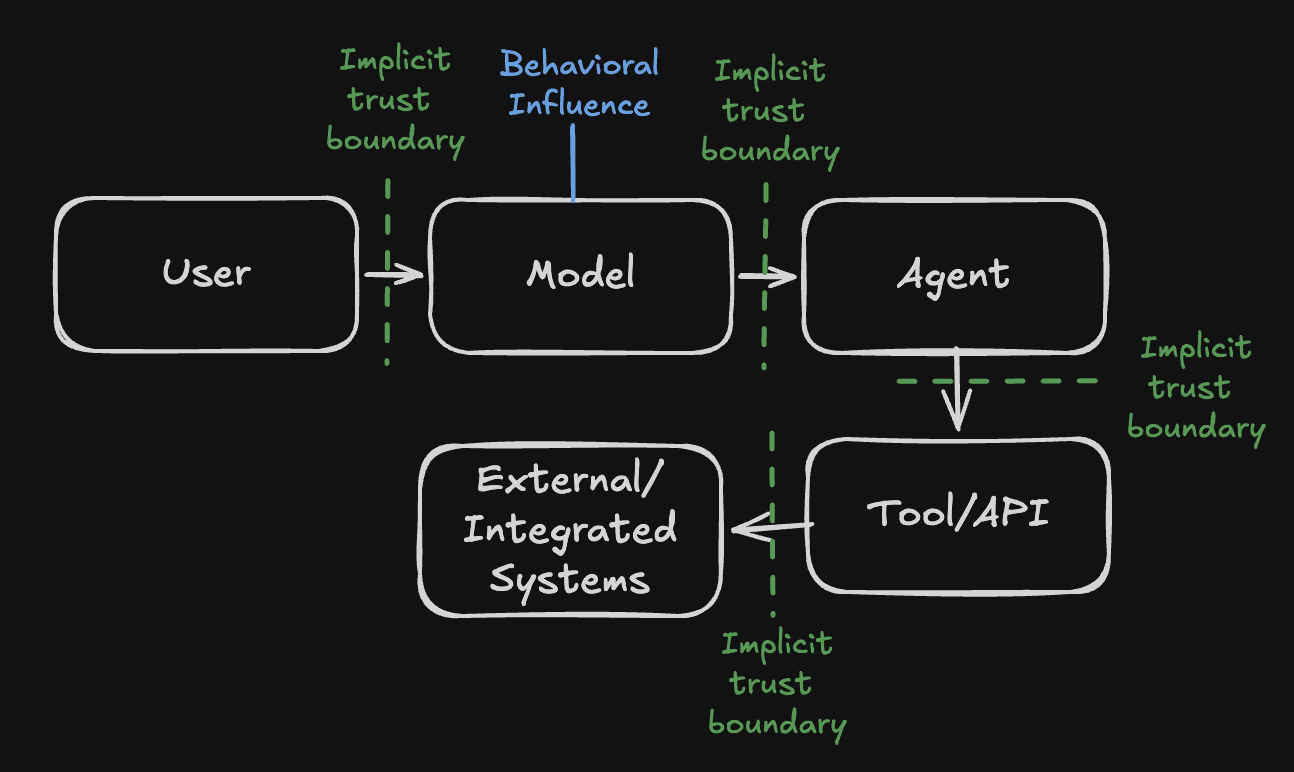
Behavioral → Technical Pivoting
How manipulation of model behavior translates into real-world system impact.
The approach focuses on identifying intersection points between:
Non-deterministic behavior (LLM outputs, agent decisions)
Deterministic systems (APIs, permissions, connectors)
TL;DR
Pattern: Behavioral Pivot Attack Path
Behavioral attack surfaces in AI systems are often treated as abstract or isolated phenomena. In practice, they are tightly coupled with traditional infrastructure and interfaces.
The most impactful risks emerge when behavioral influence becomes a bridge into deterministic systems.
Treating AI systems as either:
Behavioral systems (LLMs, agents)
Technical systems (APIs, infra, apps)
is an incomplete model.
In reality:
Behavioral surfaces are exposed through technical systems.
Web apps
Electron clients
API endpoints
Agent frameworks
These are not new attack surfaces; they are existing infrastructure now influenced by probabilistic systems.
Focusing on only one layer leads to blind spots in threat modeling.The most impactful risks emerge when behavioral influence becomes a bridge into deterministic systems.
Problem Framing
The attacker:
Has standard user-level access to an AI-enabled system
Can interact with the model through typical interfaces (chat UI, API, agent workflows)
Cannot directly exploit infrastructure in a traditional sense
Relies on influencing system behavior through interaction
The objective:
Transition from influencing model behavior → impacting underlying systems
Use behavioral manipulation as an initial access vector into technical infrastructure
Constraints:
No direct code execution assumed initially
No privileged access
Requires chaining across system boundaries
The model is not the end target.
It is the control layer.
Behavioral influence allows an attacker to:
Indirectly control how systems are used
Shape requests sent to downstream services
Bypass assumptions embedded in deterministic logic
The vulnerability is not just in the model or the infrastructure, it’s in the interaction between them.
This class of risk introduces:
Behavior-driven initial access
Cross-layer attack paths
Expanded attack surface via integration
Difficulty in detection due to plausible outputs
Unlike traditional vulnerabilities:
Attacks are stateful and adaptive
Depend on context and interaction history
Do not map cleanly to static testing
As AI systems become embedded in production environments, behavioral manipulation becomes a legitimate entry point into real systems.
The distinction between “model behavior” and “system security” is increasingly artificial.
In practice, behavioral manipulation results in control over system execution paths.
Areas of continued exploration include:
Formal modeling of behavioral → technical attack paths
Detection strategies for cross-layer abuse patterns
Isolation patterns for agent and tool execution
Policy enforcement between model output and system execution
Observability into model-driven system actions
Strict input/output validation between models and tools
Capability scoping (not just auth)
Execution gating separate from model reasoning
Auditable decision boundaries
Prompt inputs
Multi-turn interaction patterns
Tool usage pathways
Agent decision boundaries
APIs (internal + external)
Auth boundaries
Data flows
Integration points (third-party services, plugins, connectors)
How does model output influence system actions?
What assumptions exist between layers?
Where does trust transfer occur?
Over-permissioned tools
Missing validation between model → system
Implicit trust in model-generated inputs
Lack of segmentation between user intent and system execution
This is a behavioral pivot attack path where an AI agent interacts with third-party services:
Email
Slack
Cloud storage
Internal tools
If hard gates do not exist between:
User influence
Agent behavior
Connector execution
Then:
Account compromise → behavioral manipulation
Behavioral manipulation → tool misuse
Potential impact:
Sensitive data disclosure
Data exfiltration
account lockouts
Unauthorized actions across services
The failure is not just access control, it’s behavioral control over access pathways.
This is a behavioral pivot attack path where an LLM is provided access to a sandbox environment.
If isolation is insufficient:
The model can be prompted to explore its environment
Enumerate accessible resources
Interact with internal endpoints
Potential outcomes:
Discovery of internal APIs
Access to sensitive data
Execution of unintended actions
The model is not exploiting the sandbox, it is being guided to misuse it.
Threat Model
Technique Overview
Case Scenario 1: Agentic Workflow + Connectors
Case Scenario 2: Sandbox Escape via Behavioral Control
Key Insight
Security Implications
Why Does This Matter?
Future Work/Research
Defensive Considerations
Step 1: Enumerate Behavioral Surfaces
Step 2: Enumerate Technical Surfaces
Step 3: Map Interaction Paths
Step 4: Identify Pivot Opportunities
The most dangerous AI failures won’t come from isolated bugs, but from behavioral influence interacting with real-world systems in unintended ways.